contributed by Jean Miller , Ph.D. & & Sharon Hastings , Ed.D, addendum by TeachThought Staff
Exactly how about some psychological health ideas for teachers?
Today, the role of teachers is increasing to include even more tasks and duties than in the past, consisting of structure mentally strong and healthy and balanced students.
However, culture usually overlooks to address or perhaps review the psychological and psychological well-being of educators themselves. This neglect has caused two significant concerns– teacher burn-out and a lack of skilled teachers offered as a result.
See likewise 5 Blunders I Made As A Brand-new Instructor
Offered their increased obligations, growing numbers of educators are battling to deal with the altering needs of their occupation. According to a recent survey of over 30, 000 instructors, performed by the American Federation of Teachers, greater than 75 percent claim they do not have enough personnel to obtain the work done, and 78 percent state they are typically physically and mentally tired at the end of the day.
The reason usually cited for leaving three-quarters of educators feeling overworked and worn down was the fostering of new campaigns without correct training or specialist growth.
With regard to the workforce, not just did educator education registration fall by 240, 000 (a 35 percent reduction) in between 2009 and 2014 however about eight percent of teachers, consisting of numerous that are well below the average old age, leave the workforce yearly.
One means to suppress this exodus and maintain our nation’s finest teachers in the classroom is to ensure they have the personal support and advancement they require to remain healthy and balanced and happy in both their personal and expert lives.
How To Support The Mental Wellness Of Educators
According to a recent College of Phoenix study on mental health and wellness, almost one-third (31 percent) of united state grownups evaluated pointed out social preconceptions as a barrier to receiving mental healthcare. This is an appropriate and frustrating fact for the education sector, as several teachers might additionally share the sentiment that looking for therapy signals weakness or a lack of ability to manage their work.
The fact is most of high-performing instructors struggle with the needs of their work; in fact, this battle causes greater than 50 percent of them to wear out in much less than five years. This stands as additional proof that our market experts have a vested interest in encouraging educators to look for the help they need so they can be better and more effective in their duties.
To provide our country’s instructors with the assistance they require, mental wellness sources like specialized counseling, continuing education and learning programs, and community efforts geared towards health ought to be prioritized.
By making mental health care a lot more conveniently available to teachers, we can aid them progress as experts and people while making strides to remove the preconception often associated with seeking psychological health therapy.
A few various other psychological wellness tips for instructors?
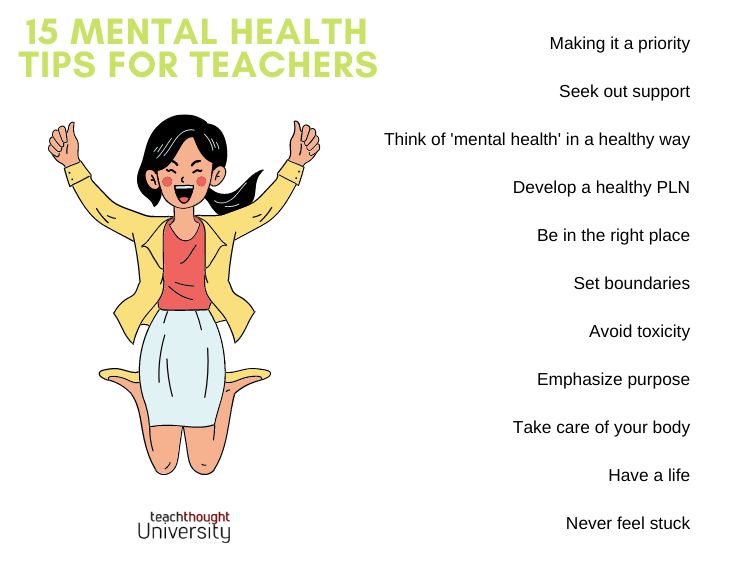
15 Mental Health Tips For Educators
1 Make it a mental health concern
Most importantly, mental health and health finest practices must be integrated into training programs early in teacher education and learning. It’s up to higher education and state qualification boards to take the lead in developing these programs, to guarantee that psychological health and wellness ends up being a priority in our institutions and that all instructors are supplied the sources they require to do well and stay healthy.
There’s a reason excellent educators stopped
2 Seek out or establish resources, programs, and policies
Area leaders additionally have a duty to play in establishing psychological health and wellness cultures in colleges throughout the country. As a 2nd action, institution systems need to invest in the psychological, physical, and social health of their most valuable possession– their teachers. By acknowledging and compensating instructors for all that they do (also the ‘little’ things), urging using small teams and therapy, and focusing on psychological health, managers can have a remarkable, positive effect on the lives of their teachers.
3 Mount ‘psychological health and wellness’ in your very own mind in a healthy and balanced way
Do not call it ‘mental health and wellness’ if an expression like ‘well-being’ makes even more feeling.
4 Expand a healthy PLN
A strong expert learning network — both inside and beyond the college building.
5 Remain in the appropriate location
A work placement that they really feel comfy with– i.e., the ‘ideal’ fit for the instructor in terms of setting, quality degree, college plans, and so on. Not every work is a suitable for everybody. Well-intentioned people may advise you that the ‘kids need you,’ but you have to deal with yourself or your teaching’s merely not lasting.
6 Establish limits
As much as feasible, clear limits in between school and home life.
7 Prevent poisoning
Avoidance of things– people, departments, boards, events, and so on– that are ‘poisonous’ while creating strategies to take care of various other not-toxic-but-still-challenging training situations
8 Stress your purpose
Advise on your own of your function as an educator– why you became a teacher. If you’re unable to recognize that vision, see if you can resolve that vision with your prompt condition. If not, that gives you a hint of what maybe should follow.
9 Develop a development state of mind as a teacher
Development frame of minds matter for students and they matter for teachers, also.
10 Instruct with gratefulness
Teach with appreciation as much as possible.
11 If you’re able, begin tiny
Focus on the good things and each day, attempt to have more advantages than bad. (That’s a beginning.)
12 Deal with your body, also
Care for on your own literally: workout, meditate, do yoga exercise, get enough sleep, etc. Whatever it considers your body to feel good.
13 If you require help, get help
Don’t be a hero. If you require official mental health and wellness support (in the form of treatment or medication), there’s no reason to be reluctant. Get it. Why wait until you’re absolutely unhappy?
14 Have a life beyond teaching
Have a life outside of mentor– one loaded with creative thinking and hope and individuals and possibility. Despite just how nobile mentor is, it’s unworthy your well-being.
15 Do not feel stuck
When possible, never ever get ‘stuck’ where you seem like you ‘need to’ educate or ‘can not stop.’ There’s always a means onward. Anytime anybody really feels ‘stuck,’ it can convince you your scenario is even worse than it really is.
Teachers are functioning daily to develop mentally solid and healthy youngsters, molding the next generation of leaders and change-makers. As educators’ responsibilities continue to grow at a quick speed, we must do all we can to sustain their psychological health. We should sustain the ‘entire teacher.’
By providing the psychological support our instructors so seriously require and deserve, we can assist them grow expertly and live better lives all while combating the educator shortage in America that is putting a stress on the entire education and learning system.
Dr. Jean Miller is the University’s Denver University College Chair, and Dr. Sharon Hastings is the scientific supervisor and supervisor of the Counseling Facility at College of Phoenix; Growing The Entire Teacher: Mental Health In Education ; 13 Mental Wellness Tips For Teachers