added by Ryan Schaaf & Jack Quinn
Every person loves video games.
Albert Einstein himself showed they are one of the most elevated type of investigation. He recognized video games are opportunities for something deeper and a lot more meaningful than a childlike waste of time. Gamings promote located discovering, or simply put, discovering that happens in groups of technique throughout immersive experiences. Often, playing video games are the first technique children make use of to check out higher-order reasoning abilities connected with creating, reviewing, analyzing, and applying brand-new understanding.
See also 50 Inquiries To Help Pupils Think About What They Think
This short article is written in 2 components. The very first, written by Ryan Schaaf, Assistant Teacher of Innovation at Notre Dame of Maryland University, presents gamification in an educational context, its many elements, and some products that replicate gamified practices. The second part, shared by classroom educator and trainer Jack Quinn, provides a direct account with viewpoint from a gamified discovering professional. Below are our mixed understandings.
Gamification In An Educational Context
Gamings have lots of aspects that make them effective cars for human knowing. They are commonly structured for players to resolve an issue; an essential skill required for today and tomorrow. Several video games promote communication, participation, and also competitors amongst players. Some of one of the most immersive games have an abundant story that generates creativity and creative imagination in its players. Ultimately, depending upon just how they are developed, games can both educate and examine their gamers. They are amazing bundles of training, learning, and analysis.
The architectural components of video games are additionally particularly suited to serve this existing generation of students. Typically known as gamification (or gameful style according to Jane McGonigal), this technique of including video game aspects such as storytelling, problem-solving, aesthetics, regulations, partnership, competitors, benefit systems, responses, and learning through experimentation into non-game circumstances has currently knowledgeable prevalent implementation in such areas as marketing, training, and consumerism with widespread success (see http://www.cio.com/article/ 2900319/ gamification/ 3 -enterprise-gamification-success-stories. html) for even more details.
In the education realm, gamification is starting to pick up heavy steam. With success stories such as Classcraft, Class Dojo, and Rezzly leading the cost, the capacity for gamification to infect increasingly more class is a forgone verdict. There are also pockets of educators in the teaching landscape that are developing their very own ‘gamefully-designed’ learning settings. The next section checks out such an environment by sharing Jack’s experiences with his own class.
See additionally 10 Certain Concepts To Gamify Your Classroom
Gamification: From Theory to Practice
I have been entailed with gamification for quite some time now. In my 9 years of experience, I have actually located games are fantastic at settling several common classroom issues such as: student participation/talk time, pupil interaction, distinction, information monitoring, and enhancing trainee accomplishment.
As a supplementary language instructor on Jeju Island in South Korea, gamification helped me increase pupil talk time by 300 %. My 250 students completed over 27, 000 ‘pursuits,’ a.k.a. added homework projects they picked to do. My leading 10 % of participants spent an hour beyond course speaking their target language daily. I was even startled on greater than one occasion to get here very early to work and find my pupils had defeated me there and were eagerly awaiting my arrival so they could start their day-to-day missions.
As a class educator in the Houston Independent School area serving colleges with a 95 % complimentary and reduced lunch populace, I have actually educated both 3 rd- grade analysis and 5 th- quality science. Each of these is a state-tested topic (that I taught for two years).
Usually in my initial year of instruction, my trainees have actually executed 1 39 times the area norm and 1 82 times the area standard in my 2nd year showing the topic. Or put another way, traditional approaches would certainly take 14 to 18 months to accomplish what I can do with video games in 10
I attribute a lot of this success to following the suggestions of Gabe Zicherman from his Google Tech Talk, Enjoyable is the Future: Understanding Gamification , where he recommends game designers to “incentivize whatever you want individuals to do.” (Zicherman, n.d.)
Therefore I make every effort to determine the vital activities my students need to exercise after that construct games and benefit systems around those actions.
Gamification in education utilizes the technicians of games– points, levels, competitors, challenges, and benefits– to encourage trainees and make finding out more interesting. Below are 20 practical, classroom-tested instances of gamification that instructors can make use of to improve motivation and involvement.
1 Giving Points for Satisfying Academic Purposes
Do pupils require to cite information from the message and assistance conclusions with proof? Honor 1 point for a solution without proof, 2 factors for one piece of evidence, and 3 factors for multiple pieces of proof. This makes evidence-based thinking quantifiable and inspiring.
2 Offering Points for Procedural or Non-Academic Goals
Wish to reduce the moment it requires to examine research? Award 2 indicate every pupil who has their exercise before being motivated. This gamifies treatments and encourages self-management.
3 Producing Lively Obstacles or Challenges
Present enjoyable barriers — challenges, riddles, or time-based obstacles– that pupils need to get rid of to unlock the following action of a lesson. These obstacles enhance interaction and mirror the challenge-reward loop in games.
4 Creating Healthy Competition in the Classroom
Attempt Educator vs. Class : Trainees gain factors collectively when they follow guidelines; the educator makes points when they don’t. If pupils win, compensate them with a 1 -minute dance event, extra recess, or decreased homework.
5 Comparing and Reflecting on Performance
After a task, give pupils with a efficiency break down — badges for creative thinking, team effort, or perseverance, plus statistics like “most questions asked” or “greatest variety of drafts.” Reflection is a core aspect of gamification.
6 Developing a Variety Of One-of-a-kind Benefits
Offer tiered incentives that attract different individualities. As an example: sunglasses for 5 factors, shoes-off advantage for 10, a positive parent message for 15, or the right to “steal” the educator’s chair for the highest possible scorer.
7 Using Degrees, Checkpoints, and Development
Track points over numerous days or weeks and allow students level up at landmarks. Higher degrees unlock advantages, mentor roles, or perk obstacles– mirroring computer game progression systems.
8 Grading Backwards
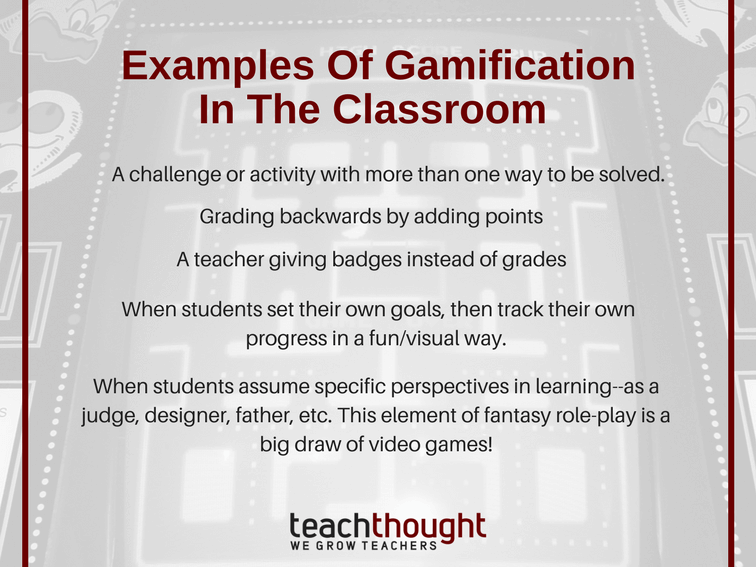
Instead of beginning with 100, allow pupils earn points toward proficiency Each correct solution, ability demo, or favorable habits moves them closer to 100 This technique reframes discovering as development rather than loss evasion.
9 Developing Multi-Solution Obstacles
Style tasks with more than one legitimate option and urge students to contrast methods. Compensate creative or special solutions to motivate divergent reasoning.
10 Using Discovering Badges
Rather than (or along with) qualities, offer digital or paper badges for accomplishments like “Critical Thinker,” “Collaboration Pro,” or “Master of Portions.” Badges make learning goals concrete and collectible.
11 Letting Pupils Establish Their Own Goals
Allow students to set individualized objectives, after that track their progress visually on a class leaderboard, sticker label chart, or electronic tracker. Self-directed goal-setting is inspiring and teaches possession.
12 Aiding Trainees Think Roles or Personas
Usage role-play to have trainees serve as courts, designers, or chroniclers while dealing with jobs. Role-based learning take advantage of the immersive nature of games.
13 Classroom Quests and Storylines
Wrap units or lessons in a narrative arc (e.g., “Survive the Old People”) where trainees unlock new “phases” by completing assignments.
14 Time-Limited Manager Battles
End an unit with a collective testimonial challenge where trainees must “defeat the one in charge” (address a set of challenging issues) before the timer goes out.
15 Randomized Rewards
Use a secret benefit system : when students make sufficient factors, allow them attract from a reward jar. The unpredictability keeps motivation high.
16 Digital Leaderboards
Produce a leaderboard for cumulative factors, badges, or finished difficulties. Public recognition motivates competitive students yet ought to be mounted favorably to stay clear of shaming reduced entertainers.
17 Power-Ups for Positive Behavior
Introduce power-ups such as “added tip,” “skip one homework trouble,” or “sit anywhere pass.” Pupils can spend gained indicate trigger them.
18 Cooperative Course Goals
Set a shared unbiased — if the entire course satisfies a factor overall, they gain a group reward like a read-aloud day, a job party, or bonus offer recess.
19 Daily Streaks
Track everyday involvement or homework completion with touch technicians like those utilized by language-learning apps. Damaging a touch resets development, encouraging consistency.
20 Unlockable Reward Material
Offer bonus offer activities or secret levels (challenges, videos, enrichment troubles) that trainees can unlock after satisfying a factor threshold. This gives innovative pupils extra challenges.
Why Gamification Works
Gamification turns regular jobs right into appealing challenges, motivates inherent and external inspiration, and offers continuous comments. When applied attentively, it advertises mastery, partnership, and a feeling of progress.
Learn more regarding gamification in learning , check out game-based understanding techniques , and obtain tips for increasing pupil involvement
Benefit: Utilizing a scoreboard seating graph
Draw or forecast a seating chart onto a whiteboard/screen, and afterwards honor students points for all tasks that you intend to incentivize with sustainable rewards/recognitions at various point degrees.
Final thought
Ensure to be innovative and respond to pupil rate of interests. In my course, pupils do not take practice examinations; they fight the evil emperor, Kamico (the manufacturer of prominent test preparation workbooks made use of at my institution). We don’t just check objects for conductivity; we find the secret object which will switch on the alien spaceship’s ‘prepared to introduce’ light.
While students are accumulating factors, leveling up, and completing against each other, I am accumulating data, tracking progress, and customizing the regulations, benefits, and quests to construct positive course society while pushing pupil accomplishment. Trainees become excited to participate in the tasks that they require to do to improve, and when pupils buy-in, they make college a game worth playing.
References & & More Reviewing
McGonigal, J. (2011 Pc gaming can make a far better world.|TED Talk|TED.com [Video file] Gotten from: ted.com/
Schaaf, R., & & Mohan, N. (2014 Making college a video game worth playing: Digital video games in the classroom SAGE Publications.
Schell, J. (n.d.) When games invade the real world.|TED Talk|TED.com [Video file] Fetched from https://www.ted.com/talks/jesse_schell_when_games_invade_real_life
Zicherman. (n.d.). Fun is the Future: Mastering Gamification [Video file] Fetched from youtube.com
12 Instances Of Gamification In The Classroom