by Terry Heick
Exactly how can you tell if a trainee truly understands something?
They discover beforehand to play the video game– inform the educator and/or the examination what they ‘wish to know,’ and also the very best assessment leaves something on the table. (Truthfully, a huge part of the time pupils merely do not recognize what they don’t know.)
The idea of understanding is, obviously, at the heart of all learning, and resolving it as a problem is among the three columns of official discovering environments and education.
1 What do they need to understand (requirements)?
2 What (and how) do they presently comprehend (analysis)?
3 Just how can they best concerned understand what they currently do not (preparation learning experiences and direction)?
However just how do we know if they recognize it? And what is ‘it’?
Comprehending As’ It’
Externally, there is difficulty with the word ‘it.’ Appears vague. Bothersome. Uncertain. Yet everybody in some way understands what it is.
‘It’ is essentially what is to be learned, and it can be a frightening thing to both teachers and trainees. ‘It’ is whatever, defined with frightening terms like objective, target, proficiency, examination, examination, quality, fall short, and succeed.
And in terms of content, ‘it’ could be almost anything: a reality, an exploration, a behavior, skill, or general idea, from mathematical theory to a scientific process, the significance of a historical figure to an author’s function in a text.
So if a student obtains it, beyond pure academic performance what might they have the ability to do? There are many existing taxonomies and characteristics, from Flower’s to Understanding by Design’s 6 Facets of Understanding
The complying with activities are set up as a linear taxonomy, from the majority of standard to one of the most complex. The best component concerning it is its simpleness: A lot of these actions can be executed just in the classroom in mins, and don’t require complicated planning or a prolonged examination period.
By utilizing a quick diagram, principle map, t-chart, conversation, image, or brief response in a journal, quick in person collaboration, on a leave slip, or using digital/social media, understanding can be reviewed in minutes, helping to change testing and consternation with an environment of assessment. It can be even be displayed on a course internet site or awaited the classroom to aid guide self-directed discovering, with trainees examining themselves for understanding.
How This Recognizing Taxonomy Works
I’ll create even more concerning this quickly and put this right into a much more graphic kind soon; both of these are essential being used it. (Update: I’m likewise producing a course for instructors to assist the, utilize it.) For now, I’ll claim that it can be made use of to assist preparation, assessment, educational program layout, and self-directed understanding. Or to create crucial assuming inquiries for any material area
The ‘Heick’ learning taxonomy is implied to be simple, set up as (mainly) isolated jobs that range in complexity from less to much more. That claimed, trainees need not show the ‘greatest’ levels of understanding– that misses the point. Any type of ability to complete these jobs is a presentation of understanding. The greater number of tasks the trainee can complete the far better, but all ‘boxes inspected’ are proof that the student ‘gets it.’
36 Assuming Approaches To Assist Pupils Wrestle With Intricacy
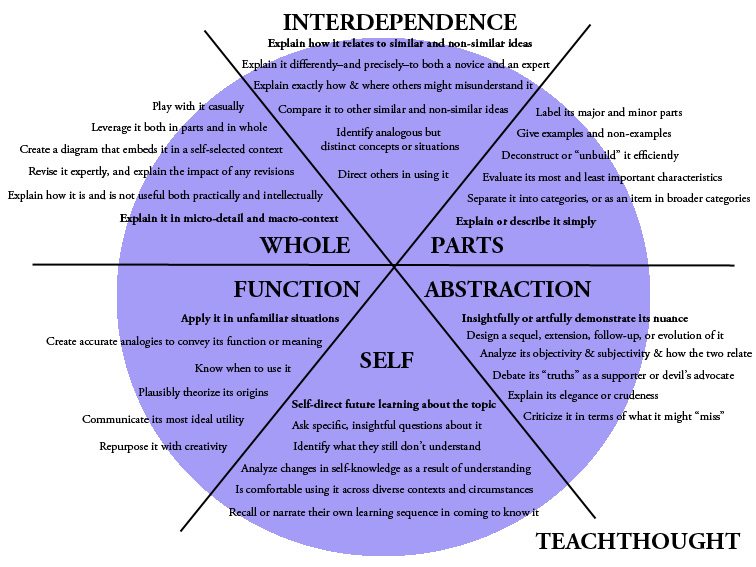
The Heick Learning Taxonomy
Domain 1: The Components
- Clarify or define it merely
- Label its major and small parts
- Evaluate its most and least crucial features
- Deconstruct or ‘unbuild’ it successfully
- Provide examples and non-examples
- Different it into classifications, or as an item in more comprehensive groups
Instance Topic
The Revolutionary War
Taste Prompts
Clarify the Revolutionary War in basic terms (e.g., an unavoidable disobedience that developed a new country).
Determine the significant and small ‘components’ of the War of independence (e.g., business economics and propaganda, soldiers and tariffs).
Examine the Revolutionary War and recognize its the very least and most important features (e.g., domino effect vs city names and small skirmishes)
See additionally 20 Types Of Questions For Educating Critical Thinking
Domain name 2: The entire
- Discuss it in micro-detail and macro-context
- Develop a layout that installs it in a self-selected context
- Clarify just how it is and is not beneficial both practically and intellectually
- Play with it casually
- Take advantage of it both partly and in entire
- Modify it skillfully, and clarify the influence of any modifications
Domain name 3: The Interdependence
- Clarify exactly how it associates with similar and non-similar concepts
- Direct others in using it
- Clarify it differently– and exactly– to both a beginner and a professional
- Describe precisely just how and where others could misunderstand it
- Compare it to various other comparable and non-similar concepts
- Identify similar but distinct ideas, concepts, or scenarios
Domain name 4: The Feature
- Use it in unfamiliar circumstances
- Produce exact examples to share its function or significance
- Assess the pleasant area of its energy
- Repurpose it with creative thinking
- Know when to use it
- Plausibly suppose its beginnings
Domain 5: The Abstraction
- Insightfully or skillfully demonstrate its subtlety
- Slam it in terms of what it may ‘miss’ or where it’s ‘unethical’ or incomplete
- Discussion its ‘truths’ as a supporter or devil’s supporter
- Explain its elegance or ignorance
- Evaluate its neutrality and subjectivity, and exactly how both relate
- Layout a sequel, expansion, follow-up, or evolution of it
Domain name 6: The Self
- Self-direct future finding out about the topic
- Ask particular, informative questions concerning it
- Recall or tell their very own discovering sequence or chronology (metacognition) in familiarizing it
- Is comfortable utilizing it across varied contexts and circumstances
- Recognize what they still don’t comprehend concerning it
- Evaluate changes in self-knowledge as a result of understanding
Advanced Recognizing
Comprehending by Design’s 6 aspects of Understanding, Blossom’s Taxonomy, and Marzano’s New Taxonomy were also referenced in the production of this taxonomy; a learning taxonomy for understanding